Yuzuru Hanyu’s Iconic Costumes and the Fashion Revolution in Men’s Figure Skating
- Carlesa Williams
- 9 hours ago
- 8 min read
A figure skating costume has only a few seconds to speak before the blades or the wheels do. In Yuzuru Hanyu’s case, it often said everything at once: softness, danger, control, myth, music, and movement.
For decades, men’s figure skating attire tended to orbit a narrow idea of masculinity. Dark trousers. Structured shirts. Military jackets. A hint of sparkle, but not too much. Hanyu did not reject that history as much as expand it. He showed that a male skater could wear chiffon, crystals, feathers, blossoms, ombré dye, sculptural sleeves, and still project athletic command.
That is why Yuzuru Hanyu’s iconic costumes and the Fashion Revolution in Men’s Figure Skating belong in the same conversation. His wardrobe did more than decorate programs. It helped reshape what audiences expect from men’s skating and what designers dare to put on the ice.

Hanyu made costume part of the choreography
The strongest skating costumes do not sit on top of a program. They move inside it.
Hanyu understood this better than almost anyone. His costumes often echoed the shape of his skating: light through the upper body, fast through the turns, and sharp at the exact moment the music demanded it. When he raised an arm, a sleeve completed the line. When he spun, layered fabric and rhinestones caught light like a visual echo of the blade.
That approach changed how many fans read his performances. The costume was not an afterthought. It became part of the story.
A few design choices appear again and again in his best-known looks:
Soft materials with athletic function Many costumes used mesh, stretch fabric, and light overlays that allowed full rotation and speed.
Asymmetry and directional detail Crystals, embroidery, and color gradients often guided the eye across the torso or down the arms, emphasizing movement.
Color as character Blue could feel spiritual or icy. Purple suggested mystery and drama. White brought purity, grief, or flight. Pink became poetic rather than fragile.
Details visible from the arena seats Hanyu’s costumes balanced close-up beauty with a strong silhouette that worked from a distance.
This matters because men’s skating happens in a huge space. A costume must register on television, in photographs, and from the upper rows of an arena. Hanyu’s best looks did all three.
They also asked the audience to accept a broader emotional range from a male athlete. Beauty did not soften the athletic achievement. It sharpened the audience’s understanding of it.
The costumes that became instant statements
Hanyu has worn many memorable looks, but some designs became reference points for both skating fans and fashion watchers. They stand out because they matched the music, the character, and the competitive moment.
The ethereal blue and green of “Hope and Legacy”
The “Hope and Legacy” costume remains one of Hanyu’s most recognizable expressions of lyrical skating. Its pale blue and green tones seemed to float between water, air, and light. The gradient effect made the body look less fixed, which suited a program built on flow and quiet control.
The design used crystals not as decoration for decoration’s sake, but as a way to create shimmer in motion. Under arena lights, the costume looked different from second to second. That quality mirrored the program’s musical rise and fall.
Its impact came from restraint. It was delicate, but not weak. It felt almost weightless, yet Hanyu’s skating gave it force. For men’s figure skating, this was a powerful style statement: softness could command a full arena.
The ceremonial power of “SEIMEI”
“SEIMEI” offered a different kind of visual authority. Inspired by the world of Abe no Seimei and Japanese court aesthetics, the costume drew from traditional shapes without becoming a literal historical reproduction.
The white base gave the design clarity on the ice. Green, purple, and gold accents added ritual intensity. The layered front panels and sharp lines suggested ceremonial dress, while the fitted skating construction kept it practical for elite competition.
This costume made a statement because it treated cultural reference with a strong visual language. It was theatrical, but controlled. It gave Hanyu a character before the music even began, then held that character through jumps, steps, and stillness.
“SEIMEI” also showed that men’s skating costumes could move beyond Western formalwear codes. The look opened space for national, historical, and mythic inspiration to sit at the center of a men’s program.

The dramatic purple and black of “Origin”
With “Origin,” Hanyu entered darker, more dramatic fashion territory. The costume, often associated with deep purple, black, and gold tones, carried a sense of intensity that matched the program’s grand musical weight.
The design nodded to the legacy of Evgeni Plushenko and earlier skating influences, while still feeling distinctly Hanyu. The rich color palette gave the body a sculptural quality. Gold details caught the light in strong flashes rather than soft glimmers.
Where “Hope and Legacy” seemed to dissolve into the music, “Origin” claimed space. It was regal, almost otherworldly. It demonstrated how men’s costumes could use ornate design without losing edge.
This kind of costume also shaped audience expectation. Viewers saw Hanyu not only as an athlete executing difficult elements, but as a performer constructing a full visual world.
The swanlike white of “Notte Stellata”
“Notte Stellata,” also known to many fans as “The Swan,” showed Hanyu’s gift for turning a costume into a breathing image. The white design, with feather-like textures and soft lines, created a clear avian impression without relying on cartoonish literal detail.
The costume worked because it trusted suggestion. The sleeves, neckline, and light-catching details created the feeling of wings. In performance, Hanyu’s upper body completed the image through posture and arm movement.
A white costume can be risky on ice. It may disappear against the surface. This look avoided that problem through texture, sparkle, and shadow. It turned Hanyu into a moving focal point, especially under a spotlight.
More than many competitive costumes, “Notte Stellata” showed how exhibition fashion can influence the broader skating imagination. It invited the audience to watch breath, line, and mood as closely as jumps.
The blossom-pink poetry of “Haru yo, Koi”
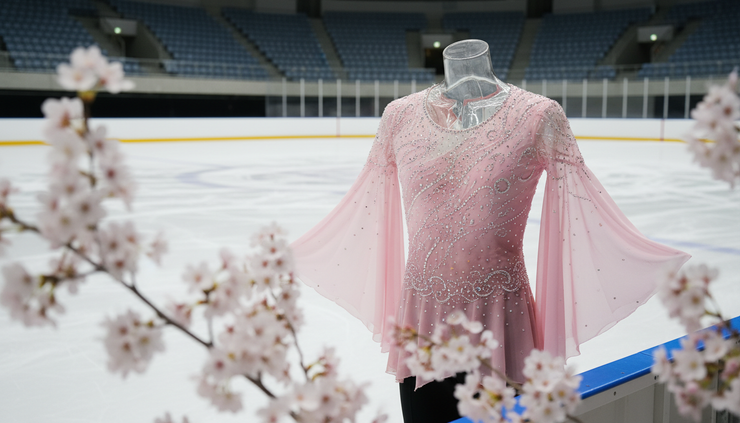
“Haru yo, Koi” brought one of Hanyu’s most striking uses of pink. The costume’s soft rose and lavender tones, often read through the imagery of cherry blossoms, created a feeling of renewal and fleeting beauty.
In men’s skating, pink has not always been treated as a neutral expressive choice. Hanyu wore it with complete conviction. The result was not costume as novelty, but costume as emotional truth.
The flowing fabric and floral impression suited the program’s tenderness. When he moved across the ice, the costume seemed to trail the music rather than simply follow the body. That visual softness made the performance feel intimate, even in a large arena.
This is one of the clearest examples of Hanyu changing the frame. He did not make pink seem “acceptable” by toughening it up. He made it powerful by honoring its delicacy.
His style changed how audiences see male skaters
Hanyu’s costumes did not become iconic only because they were beautiful. They changed the viewer’s emotional contract with men’s skating.
A traditional men’s skating costume often worked to reassure the audience: this is athletic, disciplined, masculine, safe. Hanyu’s looks asked for something more layered. They invited viewers to see vulnerability as serious. They framed grace as strength. They allowed fantasy, grief, tenderness, spirituality, and theatricality to coexist with quadruple jumps and Olympic-level pressure.
That shifted audience perception in several ways.
Fans began to read costumes more closely.
A sleeve shape, color choice, or crystal pattern became part of discussing the program. Costume analysis moved from side note to central fan conversation.
Performance identity became more complete.
Hanyu’s visual choices helped each program feel distinct. “SEIMEI” did not look like “Hope and Legacy.” “Origin” did not look like “Haru yo, Koi.” Each world had its own fabric, color, and emotional temperature.
Softness gained prestige.
Hanyu made delicate design feel elite. His costumes proved that lyrical fashion can belong at the highest level of athletic competition.
Risk became rewarding.
When a skater wears an unusual color, a sheer panel, or an ornate design, the audience pays attention. Hanyu showed that if the costume serves the program, that attention can deepen the performance rather than distract from it.
This influence reached beyond his own wardrobe. Younger skaters and designers now have more freedom to explore fluid lines, richer color stories, and cultural references. Men’s skating attire still includes the classic black shirt and tailored jacket, but the range has widened.
The change is not about copying Hanyu piece by piece. It is about the permission his career helped create.
The evolution of men’s skating attire is easier to see through Hanyu
Men’s figure skating has always had style icons. Skaters such as John Curry, Johnny Weir, Stéphane Lambiel, and Daisuke Takahashi each expanded the visual language of the sport in different ways. Hanyu belongs in that lineage, but his influence is unusually broad because of his competitive success, global fan base, and consistency of image-making.
He did not wear one daring costume and move on. He built a career-long fashion identity.
That identity blends several elements:
Athletic precision
Emotional clarity
Cultural imagination
Gender-fluid beauty
Costumes must survive high-speed rotation, deep edges, and falls without restricting movement.
Colors and textures tell the audience what kind of world the program enters.
Designs draw from music, history, nature, mythology, and seasonal imagery.
Silhouettes and details often step outside narrow menswear rules while keeping a strong athletic line.
The result has helped move men’s costumes away from simple decoration and toward full visual storytelling. A costume can now be judged not just by whether it looks flattering, but by whether it understands the program.
That is a fashion idea as much as a skating idea.
In runway terms, Hanyu often uses contrast. A costume may be delicate in color but sharp in silhouette. It may look fragile in still photos but become fierce in motion. Crystals might suggest softness during a slow passage and fire during a fast spin.
In skating terms, that contrast is gold. The sport rewards both control and abandon. Hanyu’s costumes often make that tension visible.

Why these costumes still matter
The reason Hanyu’s costumes remain so discussed is simple: they are memorable, but they are not random. Each major look connects to a musical idea, a performance style, and a version of masculinity that feels larger than sport alone.
They also remind us that fashion in figure skating is not superficial. On the ice, fabric has a job. It frames speed. It lengthens lines. It catches breath. It helps the audience understand a character before a single jump lands.
Hanyu’s fashion choices changed the conversation because they trusted audiences to appreciate nuance. A man could wear white feathers and still be commanding. He could wear pink blossoms and still be intense. He could draw from Japanese tradition, classical music, and fantasy imagery without reducing any of them to costume-shop shorthand.
That influence continues whenever a male skater chooses a color beyond black, a sleeve that extends a gesture, or a design that reveals inner life rather than hiding it. Hanyu did not invent expressive menswear on ice, but he brought it to a global stage with rare consistency and conviction.
His finest costumes endure because they do what great skating does. They turn discipline into feeling. They make technical skill look inevitable. They leave an image behind long after the music stops.

Yuzuru Hanyu’s costume legacy is not only a collection of beautiful outfits. It is a record of how men’s figure skating opened itself to more color, more texture, more softness, and more imagination. His wardrobe proved that athletic power and visual poetry can share the same blade edge.


Comments